Free Submittable alternatives for literary magazines
There is a real market of submission platforms now, and some of them are cheap. Almost none of them are free, and the ones that say they are usually mean a free tier with a lid on it. Here is what exists, what it costs, and what changes when the software is yours.
Editors come to this question from one of two places. Either the invoice arrived and it was bigger than the magazine's printing budget, or the platform changed and nobody asked them first.
Both are good reasons to look around. So look around properly, because the honest answer is that most of the alternatives are the same arrangement at a different price.
First, the word "free"
There are two completely different things wearing that label, and the difference is the whole article.
A free tier is a platform that lets you in without paying and then meters you. Fifty submissions a year. One open call. Three readers. It is free the way a sample is free, and every one of them is designed so that a magazine which is actually working will outgrow it inside a season. That is not a criticism, it is the business model, and it is fine as long as you know that the free part expires exactly when the magazine starts to matter.
Free software is a different animal. Nobody is metering you, because nobody is hosting you. You download it, you put it on a server you rent for a few dollars a month, and the number of submissions it will take is however many your server and your readers can stand. There is no plan to outgrow, because there is no plan.
What the platforms cost, as of today
I checked these on the day I published this, and screenshotted them, because prices in this market move and articles like this rot.
Submittable
The default. Magazines that belong to CLMP pay $39 a month or $290 a year, plus $0.99 per transaction and 5% of any fee on paid submissions. There is no published price for anyone who is not a CLMP member; the pricing page today sells grant management and corporate social responsibility software, and asks you to book a meeting.
On a $3 reading fee, that per-transaction fee takes $1.14 of the $3. I did the year-end arithmetic in a separate piece, and for a magazine running one fee-reading period and one contest, the gap against self-hosting came to about $1,520 a year.
Moksha
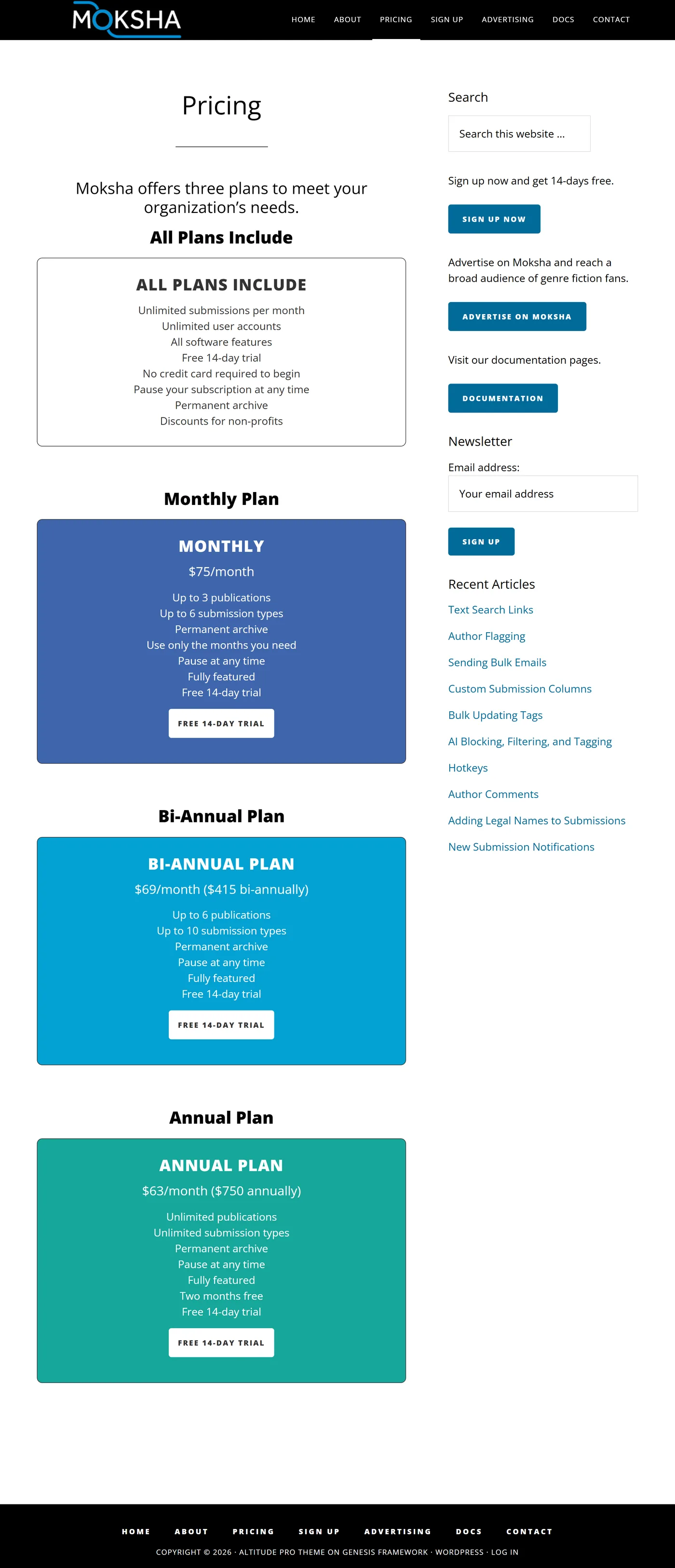
Popular with genre magazines, and a decent piece of software. It runs $75 a month, or $750 a year on the annual plan, with unlimited submissions and unlimited user accounts on every tier.
Their pricing page also promises a "permanent archive," which is a phrase worth sitting with. It is permanent in the sense that they will keep it while you are a customer. Permanence that depends on an invoice is a subscription with a nicer name.
Duosuma
Duotrope's submission manager, and the usual recommendation when someone says Submittable is too expensive. It charges by credit rather than by month, which suits a magazine that only opens a few times a year. I could not verify its current rates on the day I wrote this because the page sits behind a bot check, so I am not going to print a number I did not see with my own eyes. Go and look before you commit.
The new arrivals: Subfolio, Dapple, Ola, Galley
The last eighteen months produced a small rush of new platforms, which tells you the incumbents left room. Lit Mag Labs has been tracking them and is the best current source on what each one charges.
Treat all of them the way you would treat a new magazine asking for your best poem. Promising, unproven, and asking you to commit something you cannot easily take back. Which brings us to the one that already went.
Oleada, which is being switched off
Oleada was the quirky cheap one, and a slice of the indie world used it. It is reported to be phasing out in February 2026, replaced by a new platform called Ola. Its own site, when I checked today, still lists the magazines running on it, still says publisher accounts are in beta, and carries no notice at all about any of this.
Every editor on that platform is learning the fate of their submissions from a blog post. That is the part of this business nobody prices in.
Google Forms, email, a spreadsheet
Genuinely free, and I will not sneer at them, because most magazines start here and some good ones stay too long.
What you get is a form and a pile. What you do not get is a status a writer can check without emailing you, blind reading, reader scores, a decision history, or any way to take a fee. It works until it does not, and the day it stops working is usually the day the magazine gets its first good year, which is the worst possible day to be migrating.
What self-hosting actually asks of you
Green Submissions is the free-software answer. It is what I built to run my own journals and it is what those journals run on now.
The software costs nothing, and there is no charge per submission. It installs on ordinary PHP and MySQL shared hosting, which is the cheap kind. It carries the slush pile, blind reading, reader scoring, statuses and decisions, revisions, contest fees straight into your own PayPal, and a contributor directory. The manuscripts sit on your server in your database.
Here is the bill it does hand you, stated plainly, because you should decide with your eyes open:
- You need a server. A shared-hosting plan, the sort a small magazine's website already sits on. Call it $60 to $150 a year.
- An afternoon to install it. Create a database, upload the files, follow the installer.
- Backups are yours now. Nobody else is remembering them. This is one scheduled database dump, and it is the price of the archive being yours.
- Nobody is on call at midnight. If your host goes down during a reading period, that is your host and your problem.
- No discovery feed. Writers browsing a platform's list of open calls will not stumble on you. You get found through your own site, which is the trade — and it is the trade I would take, because every link then points at your magazine instead of theirs.
That is the deal. A few dollars a month, an afternoon, and a backup job, in exchange for never paying a subscription and never wondering who is holding your submissions.
Choose it honestly
If your magazine reads two hundred submissions a year, charges nothing, and you would rather never touch a server, a free tier somewhere is fine and I would not try to talk you out of it.
But if you charge a fee, if you run a contest, if you are reading in the thousands, or if you intend for this magazine to still be here in twenty years, then the arithmetic and the archive both point the same direction. Spending money every year for something you could own outright, and handing over your records to hold, is a strange way to run a small press that claims to value independence.
Sources, checked 11 July 2026
Prices in this market change. Everything below was read and screenshotted on the day of publication. Outbound links are marked nofollow.
- Submittable Help Center, CLMP plan — $39/month or $290/year; "$.99 processing fee per transaction, plus a 5% charge per fee amount for paid submissions."
- Submittable pricing page — no published price and no literary plan on 11 July 2026.
- Moksha pricing — $75/month, $415 bi-annually, $750 annually; unlimited submissions and users.
- Duosuma — current rates not verified here; the page was behind a bot check on the day of writing.
- Kendall Dunkelberg, 4 December 2025, reporting Lit Mag Labs — Oleada to be phased out February 2026 in favour of Ola; Subfolio and Dapple as new entrants.
- oleada.io — still live, still listing magazines, no shutdown notice, on 11 July 2026.
Or own the thing outright.
Green Submissions is free software, not a free tier. Download it, put it on your own server, and stop counting submissions against somebody's plan.