Own your submissions
Writers hand you unpublished work and trust you to keep it. Most magazines are keeping it in a room they rent by the month, on terms that can change without a conversation.
Independent magazines are strange about this. We will argue for a week about a comma. We will refuse an ad because the money feels wrong. Then we hand the entire operation, the manuscripts, the reader notes, the contributor list, the payment flow, to a company we have never spoken to, on a contract we did not read, and call it a tool.
It is not a tool. It is the building. And you do not own it.
The vendor's priorities are not your priorities
You do not have to imagine this one. Submittable's help centre still carries a line from 2022 that says, plainly, "Literary journals were our first customers." It is true, and it is why half the people reading this have an account there.
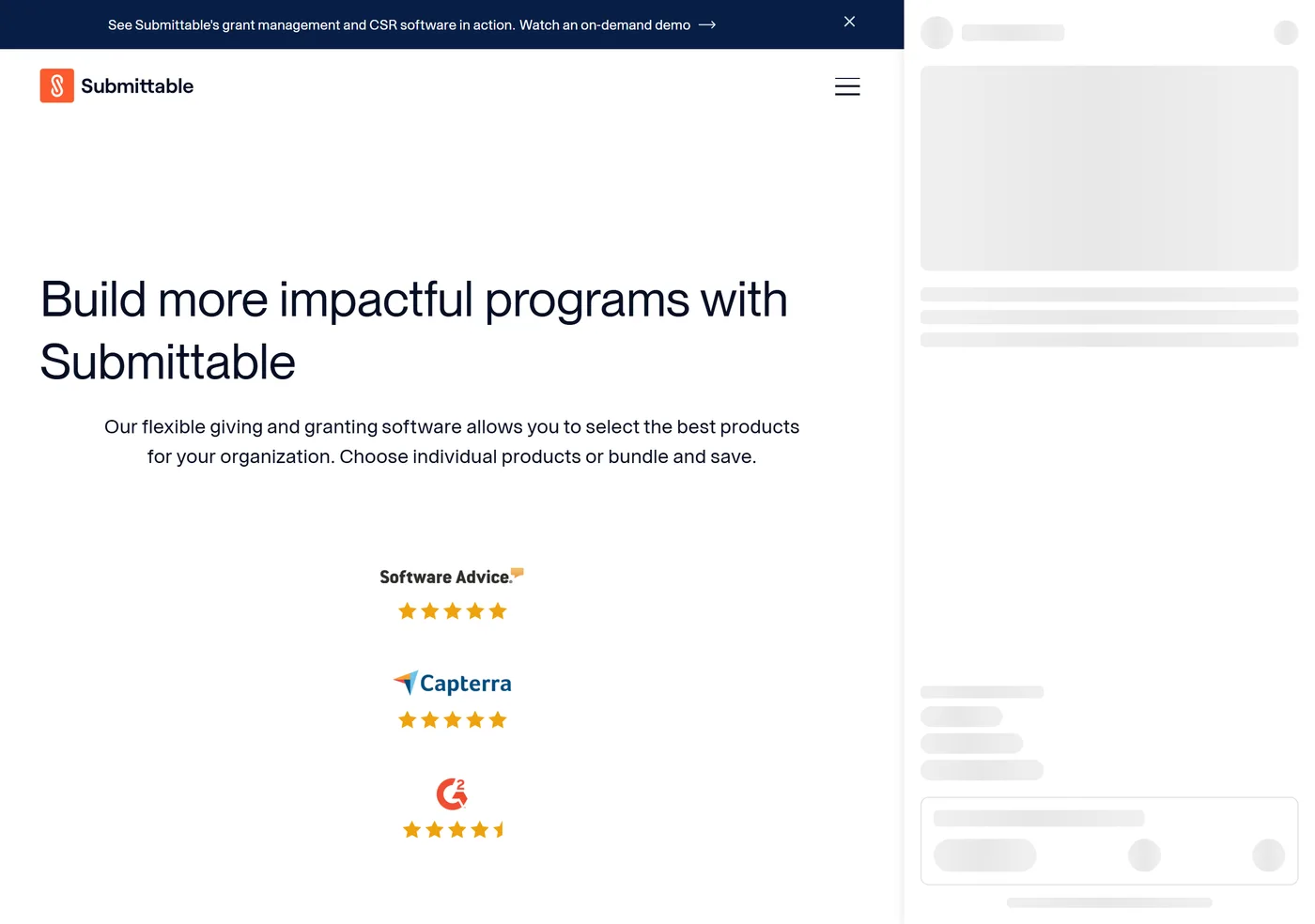
Now open their pricing page. Today it sells a corporate social responsibility platform, grant and application management software, and an enterprise tier. Three products, three buttons that say Book a Meeting, no prices, and no literary magazines anywhere on it.
Nobody did anything wrong here. Corporate grant programmes have budgets; poetry magazines have bake sales. Any company will drift toward the customer who can pay, and the literary magazines that built the early business become a legacy segment with a discount code and a help article from four years ago.
That drift is the risk, and it is invisible until the day it lands on you as a price change, a feature that quietly stops being maintained, or a product decision made for a customer who is nothing like you.
Custody, not just access
Ask where an unpublished manuscript physically is right now. Not who can log in and see it. Where it is.
If the answer is a company's cloud, then a writer's unpublished novel excerpt, their real name, their email, their postal address, and your readers' candid notes about their work all live on hardware you have never seen, governed by a policy that can be revised with an email you will not read.
Most days that is fine. It is fine right up until the terms change, or the company is acquired, or someone decides the corpus of manuscripts sitting in the database is an asset worth doing something with. You will find out about it the way everyone finds out about it, which is afterwards.
Self-hosted, the manuscript is a file in a folder on a server you rent, and the record is a row in a database you can open. Nobody has to grant you access to your own contributors, because there is no gate between you and them. That is what ownership means: it is not a better plan, it is the absence of a landlord.
Software you can actually read
Green Submissions is plain PHP and MySQL. That sounds like a technical detail. It is really a political one.
When the software is closed, every question ends at a support ticket. Can we add a field for content warnings? Can we score on a four-point scale instead of five? Can we stop the system emailing writers that phrase we hate? The answer is either yes because it is already a setting, or no forever. There is no third option, and there is no appeal, because it is not your code.
When the software is yours, the answer is always yes, and the only question is who does the work. Any competent PHP freelancer can change a form field or a template. You are never waiting on a roadmap, and you are never told that a thing your magazine needs is not a priority this quarter. I wrote separately about what that looks like in practice.
The money stays where you can see it
On a hosted platform the writer pays the platform, and the platform pays you, later, minus their cut. On a self-hosted install the writer pays your PayPal account, and it is in your PayPal account.
That is not only cheaper, though it is that. It means the reading fee your writers pay goes into the magazine on the same day, and the ledger of who paid what is in your own database. If you ever have to answer a question about a contest entry from three years ago, the answer is a query away rather than a support request to a company that may no longer have the record.
What you give up, said plainly
I am not going to pretend this is free of cost, because you will find out in week two and then you will not trust anything else I said.
You take on a server. It is a shared-hosting plan, the same kind your website already runs on, and it costs a few dollars a month, but it is yours to keep alive. You take on backups, which is one scheduled database dump and the discipline to check it occasionally. Nobody is on call for you at two in the morning. And you give up the discovery feed, the place where writers browse open calls and stumble onto magazines they had never heard of.
That last one is a genuine loss and I will not wave it away. What you get back for it is that every writer who finds you, finds you, on your own domain, where your archive and your back issues are one click away instead of a competitor's call for submissions.
The test
Here is the question I would put to any editor still deciding.
If the company holding your submissions announced tomorrow that it was closing in ninety days, what would happen to your magazine? Not to your subscription. To the record of every writer who ever trusted you with a manuscript.
If you cannot answer that comfortably, you do not have a submissions system. You have an arrangement, and somebody else is holding the good end of it.
Sources, checked 11 July 2026
Verified and screenshotted on the day of publication. Outbound links are marked nofollow.
- Submittable Help Center, CLMP plan article (written 14 January 2022, live 11 July 2026) — "Literary journals were our first customers."
- Submittable pricing page — on 11 July 2026: corporate social responsibility, grant management, and enterprise products; no published prices; no literary plan.
Take the building back.
Free software, your server, your database, your PayPal. Green Submissions installs on ordinary PHP and MySQL hosting in an afternoon.